2013-01-30

Our freedom belongs in usufruct to the living

Spain has not been a democratic country for most of its history. Last century, we had a democratic government from 1931 to 1936, a civil war for three years (a very hard and unequal fight against a pro-nazi general), a long dictatorship, first elections in 1977, a Constitution in 1978. General Franco died in 1975. Spanish Constitution was drafted with fear --in fact, some generals tried to abolish democracy in 1981. So, we the people of Catalonia are bound, aren't we?, to that Constitution passed by the dead, as I see now, with a little help from Thomas Jefferson (a letter to James Madison) --in Jefferson, Thomas. Appleby, Joyce and Terence Ball, ed. Political Writings. Cambridge: Cambridge University Press, third printing 2005, first published 1999, pages 593-598).


Paris, September 6, 1789

Dear Sir, -- I sit down to write you without knowing by what occasion I shall send my letter. I do it because a subject comes into my head which I would wish to develop a little more than is practicable in the hurry of the moment of making up general dispatches.

The question Whether one generation of men has a right to bind another, seems never to have been started either on this or our side of the water. Yet it is a question of such consequences as not only to merit decision, but place also, among the fundamental principles of every government. The course of reflection in which we are immersed here on the elementary principles of society has presented this question on my mind; and that no such obligation can be transmitted I think very capable of proof. I set out on this ground which I suppose to be self evident, "that the earth belongs in usufruct to the living"; that the dead have neither powers nor rights over it. [...] What is true of every member of the society individually, is true of them all collectively, since the rights of the whole can be no more than the sum of the rights of individuals. [page 593]

[...]

It can be proved that no society can make a perpetual constitution, or even a perpetual law. The earth belongs always to the living generation. They may manage it then, and what proceeds from it, as they please, during their usufruct. They are masters too of their own persons, and consequently may govern them as they please. But persons and property make the sum of the objects of government. The constitution and the laws of their predecessors extinguished them, in their natural course, with those whose will gave them being. This could preserve that being till it ceased to be itself, and no longer. Every constitution, then, and every law, naturally expires [...]. If it be enforced longer, it is an act of force and not of right. [page 596]

2012-12-31

Catalan National Assembly constant campaign

¬¬¬¬¬

Catalan National Assembly is always campaigning on independence. Last Friday I was supporting a team at a main street in my neighborhood (Sants-Montjuïc), in Barcelona. We gave brochures to everybody. We talked to many. It is a cheap and effective way to reach all kind of people. Catalan National Assembly is a grassroots, democratic, peaceful, non-partisan organization. It is organized through local and regional assemblies. For instance, I am working in Sants-Montjuïc per la Independència (Sants-Montjuïc for Independence; we are 1.200 activists in the neighborhood).

I picked up a brochure in English. I copy its text:

For our future: independence!! 
Assemblea Nacional Catalana

Independence for Catalonia:

  • To bring to an end the plundering fiscal tax of 60 million euros a day.
  • To have a first-class health system.
  • To have a satisfactory pension system and an effective employment policy.
  • To promote the establishment of leading companies.
  • To have a sound infrastructure, well-connected international ports and airports and modern trains that are safe and efficient.
  • To have Catalan sports teams that compete internationally.
  • For Catalan to be the common language used in trade, product labeling, justice, media, brochures...
  • To ensure immersion in Catalan at school, as a way of integrating everyone.
  • For Catalan to be a language of official use in Europe and international organizations.
  • To have our own diplomatic representations and defend our legitimate interests worldwide.
  • To be one of the most advanced states of Europe, simply by virtue of everyone's efforts.
  • To be a nation that is respected everywhere.

For all these reasons and many more...
we want an independent Catalan State!

www.assemblea.cat | Sants-Montjuïc per la Independència | www.smxi.cat


--

2012-12-19

We agree on independence

¬¬¬¬¬

Catalan activism and media are fast. Before midnight, we had a translation into English of the agreement on holding a referendum, by Liz Castro, and a wide selection of the first international media that were covering the topic, by Vilaweb:


Also worth reading is a sharp editorial by Vicent Partal: "The Moment We've Been Waiting Centuries For".


Artur Mas, leader of the center-right party, 
and Oriol Junqueras, leader of the main center-left party 
(December 18th), by Vilaweb

Catalan National Assembly supported the agreement between
both parties, on December 15th. This photo and the linked one
were made by Josep-Lluís Gonzàlez (Creative Commons by-sa)

--

2012-12-07

The Spanish plan against language immersion

¬¬¬¬¬

The Spanish government is promoting a law on educational quality. It intends to put the Catalan language in a secondary position in Catalan schools.

This is Catalan National Assembly's declaration about the Spanish plan:

  • This bill is the most serious attack the Catalan language since the end of Franco's dictatorship. It is a cowardly attack, issued after the parliamentary elections in Catalonia. The Spanish political and judicial apparatus pushes a systematic approach of contempt and margination of the Catalan language, especially regarding the educational model of immersion.
  • The law denigrates the Catalan language, and it undermines the cohesion of Catalan people. It stands for segregation and division between Catalan speakers and Spanish speakers. It tries to create a conflict that did not exist in Catalonia. We chose our educational model freely and we will not allow any interference that violates our will. The language immersion and the use of Catalan as basic language in schools is a successful model, which is recognized by experts and institutions.
  • The attack of the Spanish government can not be separated from the political context. It had never gone this far in over thirty years of parliamentary monarchy, because we had never been so close to reaching freedom.
  • The only possible answer to this bill is civil disobedience and the raising of a united front of parties, unions, organizations and society against this new attack, in a forceful, peaceful and clear response.
  • Once again, it appears clearly that independence is the only and desirable solution for Catalonia's economic and cultural survival. Any false exit will not solve the aspirations of a society, as evidenced by the results of elections on November 25th, that opted mostly for Catalonia to be the next state in Europe.
  • These attacks and these difficulties give us more strength to build persistently a new country, an exciting and inclusive project for all Catalans.
  • Catalan National Assembly supports the response to this attack that emerged from Som Escola (We are School), and calls on its members and society to defend the Catalan school.
INDEPENDENCE IS FREEDOM
CATALONIA NEW STATE

Full text (in Catalan), by National Catalan Assembly

--

2012-11-26

Elections on November 25th

¬¬¬¬¬
  • Pro-independence parties: 87 deputies.
    • CiU: 50 deputies (-12)
    • ERC: 21 deputies (+11)
    • CUP: 3 deputies (+3)
    • ICV: 13 deputies (+3) --they are pro-referendum, not exactly a pro-independence party
  • Unionist parties: 48 deputies
    • PSC: 20 deputies (-8) --they stand for a Constitutional reform and federalism
    • PP: 19 deputies (+1)
    • C's: 9 deputies (+6)
  • Participation: 70%
  • See also a detailed analysis: "Mapping the Catalan Elections results. Pro-referendum parties win" (video, 10' 13'', by Vicent Partal and Vilaweb)


Àmplia majoria sobiranista al parlament

By Vilaweb

--

2012-11-20

The astonishing vulgarity of Spanish politics and media

¬¬¬¬¬

On September 12th, Le Monde wondered why Spanish mass media had hidden the amazing march in Barcelona, the day before. In fact, denying an unconfortable reality is an ordinary practice in Madrid mass media. The worst case: Spanish government and media explained that ETA was the main suspect after Madrid train bombings on the morning of 11 March 2004. Evidence from international media finally provoked a wave of indignation against the liar government and an unexpected political change on Sunday elections (March 14th).

After the September 11th rally in Barcelona, the first Spanish reaction to Catalan movement for independence was denial. The rally was a secondary news, although editorials and opinion articles stressed the need of unity since the aftermath. Spanish parties and institutions unanimously positioned against independence. On September 20th the Spanish Prime Minister officially rejected any tax agreement in a meeting with Catalan president Artur Mas. On September 25th President Mas called for early elections on November 25th. Main interpretation by Spanish media: Mas uses independent movement for his own sake. You can see some Spanish statements about the process in the detailed chronology of events since September 11th.

Two months later, Spanish opinion has not yet changed. These are the main 5 arguments against independence:

  1. Denial of Catalonia as a nation, specially abroad. Catalonia has no history. Catalonia has no right to decide
  2. Constitutional dogmatism: the Spanish Constitution does not allow a referendum on self-determination
  3. Eternal exclusion from European Union: EU will exclude Catalonia and Spain will never allow its return to any international organitzation
  4. Fear: more crisis, less jobs, no money for retired people, frontiers
  5. Demonization of independentism, as an aggressive, totalitarian, even neonazi, movement.

The pervasive Spanish ideology is fed by a general education system that did not completely break from totalitarian years: children do learn to feel themselves Spaniards, as a kind of monolitic nation, disregarding diversity and minorities. This ideology is also backed by powerful uniform mass media and by influent civil servants in Madrid. A great, free, united Spain becomes a kind of general whishful thinking. There is no public debate. Changing the status quo is not possible, despite the institutional crisis. Questioning this traditional ideology always generates a strong irrational conflict: a sentimental and angry response mixed with a feel of social distress. Understanding Catalan independentism is not politically correct since the Spanish ideology considers any agreement as a surrender

Recognizing the right to decide is a rare position even among Spanish intellectuals: there is not any proposal for strengthening autonomy, protecting Catalan culture or revising Catalonia's fiscal deficit. Maybe we'll see it next week, after elections --too late!

--

2012-11-11

From the Dutch Revolt

¬¬¬¬¬

Many Spanish politicians tell that Spain's history begun in 1469, when the crowns of the Christian kingdoms of Castile and Aragon were united by the marriage of Isabella I of Castile and Ferdinand II of Aragon. In 1492, the combined forces of Castile and Aragon captured the Emirate of Granada, ending the last remnant of a 781-year presence of Islamic rule in Iberia. This marriage led to what would become the Kingdom of Spain under King Philip II, son of Charles V, Holy Roman Emperor. The Crown of Aragon existed until it was abolished by the Nueva Planta decrees issued by King Philip V in 1716 as a consequence of the defeat of Archduke Charles in the War of the Spanish Succession (1714, September 11th).

Spanish politicians argue that Catalonia has no history. So, Catalonia has no right to decide. For instance, the Spanish ambassador to the United Kingdom, Federico Trillo, sent a letter to Financial Times in which he claims that Scotland and Catalonia are very different cases: "Scotland was an independent nation and has been part of the United Kingdom since the Scottish parliament decided freely to join in the 18th century. By contrast, Catalonia was part of the wider Kingdom of Aragon and has been an integral part of Spain since its inception, more than five centuries ago". Last week, the Spanish Minister of Foreign Affairs ordered his diplomatic offices to start a campaign against independence. It is based on two points: [1] the claim that Spain desires an agreement and [2] the exclusion from European Union of an independent Catalonia.

Let's reduce Trillo's arguments to absurdity:

  • In 1469 Ferdinand was King of Aragon, King of Sicily, King of Naples, King of Majorca, King of Valencia, King of Sardinia and King of Navarre, and Count of Barcelona. Be aware, Mr Monti: Sicily, Naples and Sardinia were also Spanish territories more than five centuries ago, and Spain takes care of its unity very seriously.
  • So many aristocratic titles! Wasn't Ferdinand also King of Catalonia? No. It never existed a Kingdom of Catalonia, although Catalonia was the very heart of the Crown of Aragon (a confederation of kingdoms that was born in 1137). Ferdinand was Count of Barcelona because the House of Barcelona was the leading dinasty of the Crown for centuries --please, remember a similar case: the House of Plantagenet in England. When the Spanish ambassador denies any right to Catalonia, he seems to be pushing for a wider independence movement. Will Catalonia's independence produce subsequent movements in Majorca, Valencia and Aragon? Trillo is really supporting this bold alternative.
  • Is Catalonia a nation, like Scotland? Maybe it is a province, nothing more, despite the massive demonstration in Barcelona on September 11th, and according to Trillo. But... why don't most Catalans speak Spanish and speak Catalan instead, a Romance language like Italian, Portuguese or French? 
  • Did Catalonia decide freely to join Spain? Some wars demonstrate quite the contrary. The War of the Spanish Succession (1701-1714) is a nice example.
  • Charles V, as grandson of Isabella I of Castile and Ferdinand II of Aragon, inherited even wider possessions. His son, Philip II, as everybody remembers, was the lord of the Seventeen Provinces of the Netherlands... Is the Spanish president thinking endlessly about the bailout only? Would he rather be remembering the old Spanish Empire and Alva, the 'Iron Duke'? Of course, we will not know it because we will not ask Trillo for advice.

Catalonia's struggle for freedom is older than the Spanish ambassador could imagine. I was reading The Dutch Revolt, a book edited by Martin van Gelderen (Cambridge: Cambridge University Press, 1993, reprinted 2001): "The volume presents five texts which were published in the Low Countries between 1570 and 1590, during the crucial decades of what is nowadays labellled, with understatement, the 'Dutch Revolt'. From 1555 a series of revolutionary events led to the abjuration of Philip II by the States General of the Dutch provinces in 1581 and to the subsequent foundation of the 'Dutch Republic of the Seven United Provinces'" (page vii).

The Dutch Revolt (pages 15-18) provides us with a contemporary testimony about the troubles and calamities of Aragon under Spanish Inquisition five centuries ago, as the first device of Castilian domination over all Spain:

It is now near a hundred years ago since the most noble Ferdinand and Isabel, King and Queen of Castile, having ended their great and long war against the Mohammedans, which had invaded, inhabited and troubled the kingdom of Spain by the space of almost 800 years, and having chased the said enemies out of all Spain and recovered the kingdom of Granada, gave their minds to establish religion, and to root out all the remnants of the wicked Mohammedan and Jewish sects. The charge hereof was committed to the Friars of Dominic's sect, who had wholly possessed the King's and the Queen's hearts and ears with a great estimation of holiness and wisdom: and therewith were also given them full authority in all things that might seem requisite to so great a matter. [...]

These [the Dominicans], either for that they had some fervent zeal of religion, or for that they cunningly cloaked their ambitious pride, partly with wonderful opinion of holiness, partly by the favour and power of Princes and men of great authority to whom they were joined in friendship, kinship and alliance, partly also by corrupt and secret devices, in short time advanced this their new raised empire to so great a height, that now they not only used dominion at their pleasure over the community, but also brought into subjection to the Holy Inquisition all the liberty of all the people, and estates of the realm. [...]

These devices, though to many men they seemed strange and intolerable, yet both because they were principally provided against the most hateful enemies of Spain and Christian Religion, namely the Moors, Mohammedans and Jews, and also for that they bleared most men's eyes with the pretence of God's service and opinion of holiness, and finally for that they not a little availed to the enriching of the King's treasury, now greatly wasted with many years, to whose use the one half of the goods of all persons condemned was employed, they were daily more and more established by the earnest favours, authority and power of the most part of the mightiest persons and especially of the King and Queen themselves, until the Aragonese, who are the principal province of Spain both in right of ancient liberty, in nobility and largeness of dominion, openly resisted. They, when they nothing prevailed with king Ferdinand by humble and lowly petition, attempted by force and arms to keep out this pestilence from their country, for that they plainly saw that their liberty which they had received most large and incredible from their ancestors, and hitherto kept inviolate, should by the means be destroyed, and that [they] themselves and all theirs should be made subject to the most dishonourable tyranny of the clergy. But they prevailed not. For after many troubles, much destruction and bloodshed they were compelled in spite of their wills and per force, as the residue of Spain did, to yield their necks to stoop under this yoke of Inquisition so that the same province, than which in time past there was none or more freedom, is now in such case as at this day there is none to be found in more servitude and subjection. By terror of which example, and by great opinion of holiness which the Inquisitors had gotten by the good success in the case, it came to pass that they subdued all Spain unto them without any further resistance.

But as the greedy desires of men are naturally unmeasurable and unsatiable, this lust of dominion could not long be contained within the bounds of Spain, though they be full large [...]. Therefore of long time they think that they may lawfully enforce upon us the Spanish laws and ordinances, Spanish manners and the Spanish yoke of inquisition, abrogating all our country laws, abolishing all memory of the German* name, destroying our privileges and oppresing our liberty.

I do not mind if we lost independence in 1714 or in 1469. Five centuries ago Aragonese people, Catalan people were already struggling for freedom. Three centuries ago, in 1701-1714, they were still struggling for freedom. The Dutch Revolt reminds us of the extraordinary difficulties we can expect and convinces us that the Catalan Revolution makes sense, regardless of how it will turn out.


* Martin van Gelderen explains the origin of this text and this reference to Germany. William of Orange "sought to consolidate his contacts with French Huguenot leaders and with German princes. One of the attempts to enlist German support was a petition [this text] presented on 26 October 1570 to the Reichstag at Speyer, the Libellus suplex Imperiatoriae Maiestati. The English translation, A Defence and true Declaration fo the things lately done in the lowe Countrey whereby may easily ben seen to whom all the beginning and cause of the late troubles and calamities is to be imputed --the first text in this volume-- was published in 1571 by the office of John Daye in London." (page xv). "The Defence offered both an account of the origins and causes of the troubles in the Netherlands and a defence of the Dutch exiles and their activities. It exerted that Europe was afflicted by a conspiration of 'certain idle men', who under the cloak of religion tried as inquisitors to usurp civil government." (page xvi).

--

2012-11-08

A nation that expects Europe not to let it down

¬¬¬¬¬

On November 7th, Artur Mas explained Catalan vision for independence in Friends of Europe, a Brussels not-for-profit think tank for European Union policy analysis and debate: “I do not expect the EU to do the work for us, but I do expect it to support and promote the value of democracy”. He asked the EU, in case the Spanish state “fully rejects the possibility of the Catalan people to be consulted on its future, to give support to the democratic will of the Catalan people”. This is a selection of his lecture:


Before I come to what will be the core of my speech, may I just put Catalonia into context for you. [...] The roots of the Catalan people have always been European; their European vocation has never ceased to exist at any time in history and is as alive and present now as it has ever been.

I am the president of a country with a deep democratic tradition, which by the eleventh century had already developed the “assemblies of peace and truce”, embryo of what is regarded as the first parliamentarianism. I am the president of an institution, the Generalitat de Catalunya, whose origins lie in the fourteenth century, and in spite of the fact that it was prohibited for three hundred years, I have the honour to be its 129th president. [...]

The Paris and Rome treaties, as well as that of Maastricht, and even that of Lisbon, have been surpassed by the current crisis and there is a need to think of a new Europe that will recover its cohesion and its executive capacity so as to present itself to the world as a politically strong, coherent group, and to its citizens as a guarantee of their security and well-being and as a defender of the individual who must feel he or she is properly represented in its institutions. [...]

Let us think of the early days. Let us recover the spirit of the founders. The project of Schuman and of the founding fathers mixed pragmatism in the method with the broadest ambition in its aims. If you closely re-read the declaration of 9 May 1950, whose topicality is still surprising, you will see that it contains the basis of a project whose ultimate aim is the creation of a federal structure that will group the States of Europe together. I have named this old ambition the United States of Europe. [...]

Today’s European citizen has the impression that decisions in Europe are taken in just a few chancelleries and capitals of the most powerful member states and not in the European institutions themselves. And that the only subjects of debate are currency, market and economy. [...]

We can talk of the need to build a United States of Europe, a United States that cannot be a copy of the USA on account of the significant importance of people’s own languages and culture, as well as their own histories. But this new, much more federal, European reality must be built on the basis of those nations which, having a clearly defined territory, history, language and culture, as is the case with Catalonia, have the will, as expressed democratically at the ballot box, to be their own player in the construction of this new Europe.

Our proposition is a clear one: to cede all the powers necessary to give real strength to the European Union while implementing policies that are closer to the people in fields such as health, education and social policy in those places where this can be done more efficiently and consistently. Just as the States can not act as a brake on the construction of the European project, neither can they act as a brake on the will of those nations without statehood that democratically and peacefully express their will to be one more player in this process of European construction.

To want one’s own state within the framework of the European Union is to be willing to cede sovereignty to the European institutions. Consequently, our process is much more than the recognition of our national identity within the framework of a united Europe, it is much more than a process to what some people call sovereignty, given that we are totally in favour of a Europe with federal structures where decisions do not require interminable negotiations and lengthy ratification procedures before coming into force. When I am asked in Catalonia if I want an independent State I reply that what I want for Catalonia is its own State that must, necessarily share interdependencies within a more united and stronger Europe. [...]

***

We will be holding elections in Catalonia on 25 November. They are early elections that I have called after 1.5 million people demonstrated peacefully through the streets of Barcelona on 11 September last, and after the Spanish prime minister, Mr.Rajoy, slammed the door on the possibility of negotiating a Fiscal Pact which had been approved by an ample majority in the Catalan Parliament.

Our proposition is based on the essence of democracy, on the expression of democracy based on the right to decide. Catalonia must be able to decide democratically and peacefully what it wants its future to be within the framework of the European Union. During the course of the next four years this process will lead us, if so approved at the election, to consult the people of Catalonia about what they want their future to be.

Once the consultation process is endorsed by ballot it must be framed in the following terms:

  • Scrupulously democratic. The entire process must be endorsed in its most significant aspects by the direct decision of the people of Catalonia.
  • Absolutely peaceful. This process must show Europe and the world the way Catalans do things: with a positive spirit, the absence of violence and the willingness to reach agreements.
  • Demonstrably transparent. The process must be clear and have a defined road map. Everyone must be sure about the situation facing them.
  • With an ample majority. There must be an ample majority in Parliament on which to base the right to decide in order to start the consultation process. Having started the process this too must be endorsed by a sufficient majority, one that does not divide the country in two halves. I have always said that I would not want a majority of 50.5% against 49.5%.
  • And finally, as I have already said, the Catalan process has a vocation to remain within the framework of the European Union and the euro. It would be senseless for a nation that forms part of the European Union and the euro, and that wants to continue forming part, should not be able to do so.

Catalonia has never in its history let Europe down, now we trust Europe will not let us down.

There are those who have wanted to question the viability of a future Catalan state on account of its size, despite the fact that Europe clearly demonstrates that on most occasions it is the small states that have greater ability to respond to the new challenges that arise.

I will provide you with some data that demonstrate the viability of a future Catalan state and that demonstrate also that in the south of Europe too there are realities that work and that can work.

  • A future Catalan state would be in seventh position amongst European countries in terms of per capita GDP and, as it has been up to now, it would continue to be a net contributor to the Union. In terms of aggregate GDP we would be in thirteenth position.
  • In terms of population and territory we are a small country. With 7.5 million inhabitants and 32,000 square kilometres we would be the sixteenth and twenty-third countries in the EU-27 respectively.
  • With regard to openness to foreign trade Catalonia would occupy the thirteenth position, the European average.
  • More significant data about Catalonia: 20% of the research funds assigned to the State of Spain come to Catalonia; 28% of total exports from the State of Spain leave from Catalonia; Catalonia receives 15 million foreign tourists, representing 25.5% of the tourists who visit Spain.
  • With regard to foreign investment, Ernst & Young’s European Attractiveness Survey situates Barcelona, and by extension Catalonia, as the third most attractive area after London and Paris.

These are only some of the most basic data to demonstrate the viability of Catalonia having its own state. Please allow me to finish as I started. I am the 129th President of the Generalitat de Catalunya, the president of an ancient European nation with more than 1,000 years of history, a cradle of democracy and, as our renowned cellist Pau Casals said, with one of the oldest parliaments in the world. A nation that feels, and wants to continue to feel, European on account of its history, its traditions and its vocation. A nation that expects Europe not to let it down.

Thank you.


--

2012-10-31

The right to decide

¬¬¬¬¬

Francesc Homs, as spokesman of Catalan Government, explained today, for the first time, the path to independence after elections on November 25th. Catalan Parliament will take this path if independentism obtains a large majority. This is a selection of his lecture:


We have heard some voices --mainly in Madrid, but also some in Catalonia-- saying that the commitment undertaken by president Artur Mas and his party, Convergence and Union [Convergència i Unió or CiU in Catalan; a coalition between liberals and Christian democrats], is casual, tactical, like a kind of momentary itch that will soon disappear. [...On the contrary,] we are facing a very serious commitment. There will be no withdrawal. [...] Our proposal on the right to decide comes from many years ago, it is a reasoned proposal, it is based on our conscience. Nowadays its has a strong support from Catalan society (all surveys say the right to decide is accepted by 70-80% of the population).

Which are the foundations of the right to decide? There are three:
  1. Catalonia is a nation. [...] The people of Catalonia see themselves as a nation, they want to be a nation. [...] Catalonia is a political subject, a subject of law. It is unquestionably a demos.
  2. Democracy. [...] The right to decide can only take place in a democracy. How do you defend democracy while rejecting the right to decide? [...] Our legal framework [Spanish Constitution] should be in the service of democracy, not contrariwise. [...] Will the Spanish prime minister accept the will of the people of Catalonia? Yes or no?
  3. The third element that underlies the right to decide is our own future. Why do we want to become independent? Why do we defend democracy? Well, to serve the people, to serve the social, economic and cultural demands of Catalan society. [...] We have a project, but we have no tools to build it.

How can we exercise our right to decide? [...] The Advisory Opinion of the International Court of Justice, in The Hague, of 22 July 2010, can be considered the first document that provides the basis for the definition of an internationally recognized right to decide. In this regard, the International Court of Justice states that the legitimacy of a process based on the exercise of the right to decide is based on the following principles:
  1. Absence of violence, it is a peaceful process.
  2. It must follow a democratic process.
  3. Both parts have to try to reach an agreement.

We identify four rules that should guide this process (these four rules are inspired by the International Court of Justice in The Hague):
  1. First rule: Democracy. On September 27th, the Catalan Parliament passed a Resolution by a large majority: "We state our need to decide freely and democratically our future and urge the government to hold a referendum, mainly within the next term of Parliament.". [...] We must find technical and legal formulae that make it possible and choose the best one. There are several. You could use Article 150.2 of the Spanish Constitution in order to transfer or delegate to the Catalan Government the ability to authorize a referendum. You could use a future Catalan law about referenda. [...] It is worth bearing in mind the doctrine of the Council of Europe (Spain is a member of CE): Recommendation 1704 (2005) Referendums: towards good practices in Europe includes several statements of special relevance. [...] The doctrine of Council of Europe states the intimate relationship between democracy, the right of political participation and referenda. [...] This relationship can also be connected with rights of an international nature, such as, in particular, article 25 of the International Covenant on Civil and Political Rights and article 3 of the First Protocol of the European Convention of Human Rights. These two provisions were considered by the European Council in the referendum of Montenegro, as basic international principles on electoral right that had to be respected in that case.
  2. Second rule: the right to decide should require large majorities. 51% of the votes cast is probably not enough in a process like this. [...] By the way, we want to change and we demand ourselves a large majority. Those who want to keep us inside Spain do no even appeal to democracy.
  3. Third rule: the process has to develop peacefully and with full respect for coexistence. If these conditions fail, we should reconsider the process. However, I am absolutely convinced that this will not happen. The Catalan path to self determination is quiet and respectful. We do not want any confrontation nor breakage. This is the will of Catalans. In any case, despite the provocations that will emerge, we will not change this path, characterized by enthusiasm, hope and positive self-reliance.
  4. Fourth rule: Europe. Catalonia is Europe. It has been Europe for many centuries. [...] We now want to start a new path to freedom and future. Refusing a successful project as the European Union would be nonsense.

These are four rules that define the way we stand for our right to decide. We are certain they are the best way to hold a free referendum. Naturally, there are some pending issues: the exact date of the consultation or its legal formula, [...] or the specific wording of the question (it must be debated by all supporters to hold the referendum).

If the people of Catalonia decides so on November 25th, the exercise of the right to decide and the path to our own state will have no way back. [...] This is a serious path, really, that comes from the enthusiastic willingness to be and to do, and to conquer the future, and at the same time it is the result of reason and deep reflection from many years ago.

--

2012-10-25

Catalan National Assembly's 3 points

¬¬¬¬¬

Yesterday, Catalan National Assembly, the political no-partisan movement that organized massive demonstration on September 11th, explained its position concerning elections on November 25th. It asked people to take the path of recuperating political independence, freedom, dignity, democracy and social justice by voting political parties who want Catalonia to become a new European state.

A proposal was sent to all political parties, with the exception of conservative unionist parties PP and Ciutadans. This proposal contains three points:


We ask every political party who will participate in next elections to subscribe three points in its program:

1) The sovereignty of Catalonia resides in the people of Catalonia. The people of Catalonia are the one who must be consulted in order to decide which kind of political relationship they want to establish with other people and other states of the world.

2) We are going to work, since the beginning of next legislative term, to achieve that Catalonia becomes a new state in Europe.

3) We will work together with all other political groups in the process of constitution of the new independent state to obtain the broader consensus and to become the State of all the Catalan people.

INDEPENDENCE IS FREEDOM,
CATALONIA, NEW STATE

Full text of the proposal, by Catalan National Assembly (in Catalan; PDF: 2 pages)


Catalan National Assembly's president, Carme Forcadell

Catalan National Assembly's president, Carme Forcadell

Who is Carme Forcadell? "Despite her relatively low profile, this former city councillor was central both to organising the local plebiscites and, as president of the new assembly, in planning the September rally.  'Mas agreed with us that Catalans should decide whether we want our own state,' Ms Forcadell told the FT in her home city of Sabadell, near Barcelona. Mr Mas later made the promise of an official referendum, she says, because the rally turnout, which she estimated at over a million and a half, was so formidable. 'Our job now is to check that the next Catalan government delivers'." (Julius Purcell, "The town that started Catalan deluge". Financial Times, October 26 th).

--

2012-10-19

A detailed chronology, in progress

¬¬¬¬¬

  • September 11th
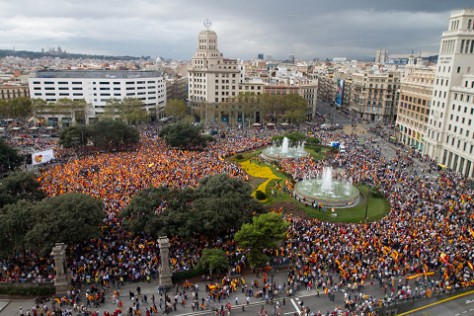
    • CATALONIA During National Day of Catalonia, 1.6 million people demonstration in Barcelona under the slogan "Catalonia, next European state". It was organized by Catalan National Assembly, a political, non-partisan movement. The President of the Catalan Parliament met with representatives from the Catalan National Assembly, who called for the process leading to secession from Spain to be started.
    • SPAIN Spanish televisions hide the march between secondary news.
  • September 12th
    • EUROPE Le Monde wonders why Spanish mass media hid the amazing march in Barcelona.
  • September 13th
    • CATALONIA Artur Mas, president of center-right Catalan Government, changes his ordinary moderate tone in a lecture in Madrid: "We the people of Catalonia need a state".
  • September 14th
    • CATALONIA Mas meets with representative members of Catalan National Assembly: "Independence is moving faster".
  • September 16th 
    • CATALONIA Public poll: 51% of Catalan population say yes to independence; 19% say no; 76% support a free referendum.
    • SPAIN Spanish socialists (PSOE: main center-left party) are against independence. Catalan socialists (PSC-PSOE) back them.
  • September 17th
  • September 18th
    • EUROPE Catalan pro-independence parties ask European Commission which are the next steps Catalonia has to take to become a new European state
    • CATALONIA Two more medium municipalities, Vic and Tortosa, declare themselves independent territory.
    • SPAIN King Juan Carlos I positions himself against independence. A kind of Iberian Commonwealth becomes impossible.
    • SPAIN Spanish vice president argues against a tax agreement, against any reform and against independence
  • September 19th
    • WORLD The United States ambassador says debate about independence is admirable. He also values peaceful and democratic demonstration on September 11th
    • SPAIN The Spanish minister of Justice says an independent Catalonia would be excluded from European Union forever
  • September 20th
  • September 21th
    • CATALONIA Municipalities of Vic and Balaguer will only raise Catalan flag from now on
  • September 22th
  • September 24th
    • SPAIN A Spanish veteran association calls Army to attack Catalonia
  • September 25th
    • CATALONIA President Mas calls for early elections on November 25th
    • CATALONIA Catalan National Assembly considers Mas's speech at Parliament as a clear pro-independence speech
    • CATALONIA Catalan priests say they are in favor of independence
    • SPAIN Another Spanish military association says that soldiers must not have political ideas 
  • September 26th
    • CATALONIA Mas, in Parliament: "I would like Catalonia to have the same power as any European state"
  • September 27th 
  • September 28th
  • September 30th
    • CATALONIA A member of universities conference says that Catalan universities will improve with independence
    • CATALONIA Catalan center-left leader Pere Navarro wins center-left conference. He says he is against independence.
    • EUROPE Viviane Reding, vice president of European Comission, says, in an interview, that an independent Catalonia would not be automatically excluded from European Union
  • October 1st
  • October 2nd
    • SPAIN Autonomous presidents conference in Madrid: Artur Mas refuses to be interviewed to preserve the unity of Spanish position about debt crisis
    • WORLD Ricard Gonzalez and Jaume Clotet (New York Times): "Spanish Prisoners"
  • October 3rd
    • CATALONIA The Catalan minister of Economy, Andreu Mas-Collell, explains to main entrepreneurs that Catalonia needs a referendum very soon
    • EUROPE The president of European Parliament rejects the vice president Vidal-Quadras's ideas: the values of European Union are freedom of speech and the right of people to demonstrate peacefully. He received 40.000 complains in 3 days.
  • October 4th
    • SPAIN Spanish Bishops Conference is against independence (17 yes, 4 abstentions, probably from Catalan bishops)
  • October 5th
    • CATALONIA Catalan bishops publish a note on the right to support any political option peacefully
    • CATALONIA "Building a New State" Conference, in Barcelona (video 3' 32'' Daniel Turp, Juan José Ibatrretxe, subtitled in English) and Stephen Tierney
    • EUROPE Report from BBC (6' 11''): "Will Catalonia say adios to Spain?"
  • October 6th
  • October 7th
  • October 8th
  • October 9th
    • CATALONIA Fundació Catalunya Estat, a Catalan think tank, publishes a clear and comprehensive relation of questions and answers about independence
    • SPAIN Congress votes against a Catalan referendum: 276 no, 42 yes.
  • October 10th
  • October 11th
    • CATALONIA 53% of members of an important industrial association say yes to independence
    • CATALONIA PSC-PSOE, left-center main party in Catalonia, splits. Some former ministers and main politicians leave the party and support Catalonia's right of self determination
    • CATALONIA A manifesto for progressive and federalist politics is published. The document attacks Artur Mas and Spanish conservatives. It prefers trying to reform Constitution rather than independence
    • CATALONIA Just before Spanish national day, a big independentist Catalan flag is made of thousands of kindles, in Vic's Central Square (video, 2' 12'': "Encén la flama", "Kindle the Flame")
    • SPAIN The Spanish minister of Education says he want to "hispanize" Catalan pupils
    • SPAIN Supreme Court allows civil servants in Catalan municipalities to ignore Catalan language
  • October 12th
  • October 13th
  • October 15th
  • October 16th
  • October 17th
    • EUROPE Artur Mas sends a letter to Cameron and a letter to Salmond in order to thank them for their extraordinary example to the world 
    • EUROPE Artur Mas presents Photonic Science Institute to consuls in Barcelona
  • October 18th
  • October 19th
  • October 21th
    • SPAIN Sunday, prime time: first full interview with Artur Mas in a Spanish TV since September 11th, by awarded journalist Jordi Évole, achieves a 13,7% share, a great hit for Évole's program Salvados (video, in Spanish: 51').
  • October 22th
    • EUROPE Four members of European Parlament send a letter to vice president Viviane Reding. They ask for avoiding in public debate any military threat as a means of resolving the political conflict. 
    • EUROPE European Commission’s vice-president, Joaquín Almunia, a fierce opponent of Catalan independence, cautions against making “categorical” claims an independent Scotland or Catalonia would not be a member of the EU. 
  • October 23th
    • EUROPE At the Strasbourg plenary, Dutch Member of European Parliament (MEP) Derk J. Eppink, vice-chairman of the European Conservatives and Reformists Group, asks vice president Vidal-Quadras to apologize and resign. "Let the Catalonians decide their own future. That is the way: not the army, democracy!" (video 3' 26''). In response to a Spanish MEP, he makes the point that he is not interferring internal affairs of Spain but he does not approve the suggestion that the Army should be send to a province.
  • October 24th
  • October 25th
    • CATALONIA Public poll: 57% of Catalan population say yes to independence; 35% say no.
    • CATALONIA 40 professional associations support publicly independence process (Economists, Architects, Doctors, Engineers, Nurses, Veterinary, Geologists, Dentists, Journalists...).
    • EUROPE An interview with Ramon Tremosa, member of European Parliament.
  • October 26th
    • CATALONIA Spanish Navy forces fish boats in Roses to return to port because they did not use Spanish flag.
    • EUROPE Alex White & Raphael Brun-Aguerre (Economic Research Global Data Watch, by JPMorgan Chase Bank N.A, London Branch), "Catalan challenge asks real questions of Europe" (PDF: 5 pages). 
  • October 28th
    • CATALONIA La Vanguardia, an important, conservative and prudent newspaper from Barcelona, publishes a long editorial about self determination (editorial "Politics, Dialogue and Boldness", in Spanish). It says that 'Catalonia is a nation', against Spanish official position. It also includes last poll: 81% want a referendum, 53% say yes to independence (35%, no).
    • CATALONIA Pere Navarro, center-left Catalan leader (PSC-PSOE), presents his program: a federalist alternative plus a constitutional reform that will allow a referendum. They will vote no to independence.
  • October 29th
  • October 30th
    • CATALONIA Catalan chancellors from public universities publicly support a free referendum
  •  October 31th
  • November 1st
  • November 2nd
    • CATALONIA Josep Antoni Duran, leader of Democratic Union of Catalonia (the Christian democratic party which is federated with Mas's party, Democratic Convergence of Catalonia), begins a series of antiindependence statements: "I cannot imagine Catalonia without Spain".
  • November 3rd
    • CATALONIA Poll: 72% support a referendum, 52% will say yes, 48% believe Artur Mas will keep the struggle until the end (75% among pro-independence voters), 72% expect a strong opposition from Spain 
    • SPAIN 300 Spanish intellectuals present a manifesto against independence, published by El País (full text, in Spanish). Although, it diverges in one point from main Spanish political parties: "If that feeling [the feeling of independence] is so mainstream and so contrary, in an irreducible and permanent way, to the maintenance of our institutions, our democratic conviction will force the rest of Spaniards to take it into consideration and find a proper and respectful solution. Citizens of Catalonia must know that this is our unwavering commitment."
  • November 4th
  • November 6th
    • WORLD 16,000 Catalans who live abroad, from a 150,000 population, will be allowed to vote, among complains about Spanish diplomatic negligence
    • WORLD "A trip to Barcelona", an insightful video (6' 03'') by Sharif, a New Yorker 
    • SPAIN 800 Galician intellectuals present a manifesto for Catalonia's right to decide (full text, in Galician)
  • November 7th
    • EUROPE Catalan president Artur Mas in Brussels
    • EUROPE Ian Traynor (The Guardian): "Catalan leader Artur Mas presses EU on secession issue"
    • WORLD Gabriele Steinhauser (Wall Street Journal Blogs): "Mas Power for Catalonia"
    • CATALONIA Catalan National Assembly and main trade unions in Catalonia present a manifesto for the right to decide. This is a global crisis, but it is getting worse because of the lack of any tax agreement with Spain and the lack of sovereignty.
    • CATALONIA Barcelona's Chamber of Commerce: 62% of entrepreneurs are pro-independence.
  • November 8th
    • SPAIN Poll about next elections (between October 9th and October 29th): Artur Mas's CiU, center-right party, does not reach absolute majority; pro-independence parties can obtain 92-93 deputies (there are 135 deputies in Catalan Parliament);  center-left unionist party, PSC-PSOE, sinks, from 28 deputies to 19, but it keeps second place; center-left pro-independence party, ERC, increases from 10 deputies to 17.
    • CATALONIA Poll about next elections (between October 22th and October 31th)  Artur Mas's CiU, center-right party, reaches absolute majority; pro-independence parties can obtain 93-98 deputies (135 deputies in Parliament); yes to independence increases until 57% (from 45% a year before); no to independence, 21% (abstentions, 14%); center-left unionist party, PSC-PSOE, sinks, from 28 deputies to 15.
  • November 9th
    • CATALONIA Electoral campaign begins.
    • CATALONIA "Cauen els murs (The Walls Come Down)" (2' 04''): a video calls for massive support to independence by comparing Catalonia's movement with the fall of the Wall in Berlin (November 9th, 1989).
    • SPAIN 40 Spanish intellectuals present a manifesto for Catalonia's right to decide, published by Público (full text, in Spanish).
    • EUROPE Catalan members of European Parliament submit a question to European Commission concerning Spanish diplomatic negligence (only 16,000 Catalans who live abroad, from a 150,000 population, will be allowed to vote, due to bureaucratic difficulties).
    • EUROPE EU allocates €63 million to bring Kosovo closer to Europe (press relesase, PDF). European Commission was authorized to initiate talks with Kosovo on March 22th (a vote was won by 522 to 110; only Spain and France opposed).
  • November 10th
    • EUROPE Viviane Reding, vice president of European Commission, says, in a public meeting in Berlin, that an independent Catalonia would be excluded from European Union (see above September 30th, October 8th and October 15th).
  •  November 13th
    • EUROPE José Manuel Durao Barroso, president of European Commission, answers a question in European Parliament: European Commission will not decide about the inclusion of a new state until the proper moment (see above September 30th, October 8th, October 15th and November 10th).
    • WORLD Bloomberg interviews Joan Vidal de Ciurana, chief-of-staff of the regional Catalan government (3' 56''): "Catalonia would weigh independence outside European Union".
  • November 14th
    • CATALONIA Col·lectiu Emma publishes "What the elections in Catalonia are really about" (also in Arabic, Catalan, Dutch, Esperanto, French, German, Italian, Russian, Spanish). 
    • CATALONIA Cultural associations publish a manifesto for Catalonia's right to decide.
    • EUROPE First pan-european general strike in order to protest against the harsh austerity measures implemented by national governments in response to the financial crisis.
  • November 15th
    • CATALONIA Col·lectiu Wilson: an academical contribution to the current debate on self-determination in Catalonia in order to help its citizens decide their own future, free from fear or unfounded threats.
    • WORLD "Someday We'll All Be Free", another brilliant video (6' 27'') by Sharif, a New Yorker 
  • November 16th
  • November 18th
    • CATALONIA Polls about next elections: Artur Mas's CiU, center-right party, does not reach half of deputies; ERC, center-left pro-independence party, may double its representation and may advance unionist parties; PSC-PSOE, center-left unionist party, sinks. Pro-independence parties can obtain 93 deputies (there are 135 deputies in Catalan Parliament).
  • November 19th
  • November 20th
  • November 21th
  • November 22th
  • November 25th
  • November 27th
  • November 28th
  • November 29th
    • CATALONIA Republican Left of Catalonia proposes a referendum on September 2013. It is a pro-independence party, with 21 deputies, the second party in the new Parliament.
  • November 30th
  • December 3rd
  • December 4th
    • CATALONIA Liz Castro, "Catalan government rejects Spanish plan against language immersion".
    • SPAIN Irene Rigau, Catalan minister of Education, leaves a conference meeting on education in Madrid to express her opposition to the motion against Catalan schools. She says that the proposals presented are “not negotiable” for the Catalans.
    • WORLD Less than 10,000 Catalans who live abroad, from a 156,000 population, were allowed to vote, due to bureaucratic difficulties: a report states that the majority of these voters are pro-independence voters.
  • December 5th
  • December 6th
    • CATALONIA During Spanish Constitution Day, 7,000 people march in Barcelona supporting union with Spain.
  • December 7th
    • CATALONIA A new popular campaign begins: "Keep Calm and Speak Catalan" --"Keep Calm and Carry On" was a propaganda poster produced by the British government in 1939 during the beginning of the Second World War, intended to raise the morale of the British public in the event of a Nazi invasion of the UK.
  • December 10th
    • CATALONIA People in more than 60 municipalities demonstrate at night against Spanish plan on education, under the motto "A country for everybody, school in Catalan". The demonstration in Barcelona achieves thousands of people in Sant Jaume Square, calling for independence. President Artur Mas receives Som Escola (We Are School), a commission of teachers, artists and civil rights activists.
    • SPAIN Two young students, Ismael and Amparo from València, reject Spanish plan against Catalan language in schools in an official meeting about human rights in Spanish Congress.
    • EUROPE Ramon Tremosa, member of European Parliament, warns about the Spanish attack to the Catalan language in schools (video, 1' 03'')
    • EUROPE Severin Carrell (The Guardian), "Scotland calls for urgent talks over EU membership".
    • EUROPE Lorraine Ryan (University of Birmingham), "Catalonia's Quest for Independence".
    • WORLD R.L.G. (The Economist), "A Spanish own goal".
  • December 11th
  • December 12th
    • CATALONIA President Mas holds general meeting with parties that support language immersion and reject Spanish plan. These parties have 107 deputies (there are 135 deputies in Catalan Parliament)
    • SPAIN Strong opposition by Catalan deputies in Spanish Congress against the plan on education (a photograph): "Don't touch our children
    • EUROPE Braden Phillips (Reuters), "Spain education plan stokes tensions with restive Catalonia".
  • December 14th
  • December 15th
    • CATALONIA Catalan National Assembly calls for center-right and center-left pro-independence parties to work out an agreement.
  • December 17th
    • CATALONIA "The beauty of dreams", by Frankly, a translation of an abbreviated version of the inspiring address delivered by Núria de Gispert (of the governing pro-independence Convergence and Union party) following her re-election as Presiding Officer of the Catalan Parliament at the first meeting of its new session.
  • December 18th
  • December 19th
  • December 20th
    • CATALONIA PSC-PSOE, center-left party (20 deputies in Parliament), will abstain in future decisions about independence. This position reduces even more the strength of antiindependece parties (there are 135 deputies in Catalan Parliament and there are only 28 deputies against independence).
    • SPAIN Spanish Government begins actions against some municipalities that declared they were free Catalan territory: Girona, Celrà.
  • December 21th
  • December 22th
  • December 23th
    • CATALONIA Interesting poll in Diari Ara: 80% of Convergencia and Union and Republican Left voters support the agreement between both parties, and only 3% are against it. 40% of center-left party PSC-PSOE voters support independence.
    • SPAIN José Manuel Romero (El País, in English) "Police chiefs using extra-legal methods to attack Catalan politicians".
  • December 24th
  • December 26th
    • CATALONIA Saint Stephen Concert, at Palace of Catalan Music: one more outcry for independence (video: 4' 16'').
  • December 30th
    • BALEARIC ISLANDS Pro-independence rally in Palma (Majorca): video 4' 16''.
  • December 31th
  • January 3rd
  • January 6th
    • SPAIN Day of Spanish Army: the Minister of Defence states that the army is ready and urges its members not to fall for provocations.
  • January 7th
  • January 8th
    • CATALONIA The Prince of Spain, the Spanish president and the president of Catalonia met at the inauguration of the high-speed rail that connects Barcelona and Figueres, near the French border. Artur Mas claims that this rail was expected to be build many years before; Spain is underfunding Catalonia
    • WORLD Sean Aday (The Institute of Public Diplomacy and Global Communication Blog) "Catalan Independence and Sub-State Public Diplomacy".
  • January 9th
    • CATALONIA An official poll from Barcelona City Council, made in December: pro-independence parties increase votes in Barcelona and win.

2012-10-07

Some key statements by Catalan leader Artur Mas

¬¬¬¬¬


Although Artur Mas, the leader of Catalonia, did not attend the independence demonstration on September 11th, he changed his tone from then on. He was unprecedentedly clear in Madrid two days later, in a public speech addressed to Spanish businessmen and politicians. He raised the pressure a week later, after Spain's president rejection to a fiscal agreement (The government of Catalonia is pauperizing itself by paying $20 billion more per year in taxes than it receives in services from Madrid, with the paradoxical result that the regional government is forced to beg money back from Madrid).

President Mas spoke about the demonstration on September 12th:
  • "Yesterday, the people who came out on the street weren't just angry, hostile, ignorant people, they were people with huge civic spirit and patriotic feeling. People who love their country and who are ready to defend it and the only thing they want for Catalonia is what other countries in the world have."
  • "During 30 years [since general Franco's death], part of Catalonia's energy as a country have gone to help the Spanish state be a better country, with the hope that these efforts would help configure a state that was more open and respectful toward Catalan aspirations and in a territory in which progress could be achieved from the point of view of the progress of our self-government. We have spent 30 years in this way, and now there has been a change of direction, a new path."

 President Mas called for early elections in Catalan Parliament on September 25th:

  • "The voice from the street has to be expressed at the polls [...]. It's time for Catalonia to exercise its right to self-determination."
  • "It is the people of Catalonia who are the rightful masters of their own destiny, and who should decide who should represent them in these historic moments, and with how much strength, and how much legitimacy."
  • [The call for elections] “is the only way to know if those who didn't go to the demonstration are all against what was declared there, or if all those who went were actually in favor [...] This is the greatness of democracy.”
  • "In exceptional circumstances, that may well have a weighty historical dimension, what is paramount is the verdict of the people, who must, with their vote, decide which paths should be taken in the future”.
  • “Once the national objectives that the Catalan people decide on have been achieved, I will not run for re-election. [...] Objectives might be achieved in the next legislature, better in one than in two”.
  • “The path that Catalonia is prepared to follow is full of obstacles. [...] There will be insults, provocations, and threats of all kinds. [...] Language and geographic origin will be manipulated in order to pit people against each other. [...] Catalonia will have to construct large majorities, and have a strong will and a huge capacity for resistance. [...] Nothing will be easy, but everything is possible.”
  • “We needn't look for outside enemies, we must only concentrate on our interior strength as a people and as a nation”.
  • [Fiscal agreement was] “a good opportunity for repairing the relationship between Catalonia and the rest of the State and reversing the growing fatigue between the two. [...] Time will prove that the Spanish Socialist Party and the People's Party have acted with gross political shortsightedness”.
  • President Rajoy's proposed to bring the fiscal pact to the Spanish Congress. Artur Mas explained that his answer was no “because I wasn't willing to go undergo further tribulations or humiliation. This time, it won't be the [Spanish] Congress who votes, but rather we the People of Catalonia”. 
  • “This is not the time for institutions to play it safe [but rather] to go for it, beyond personal comfort or partisan interests. [...] It is the People of Catalonia, authentic masters of their own destiny, who should decide who should represent them in these historic times, and with how much strength and legitimacy."
  • “We the Catalans want respect for who we are and not to have to beg every day nor have to justify ourselves for being what we are. [...] We want the same instruments that other nations have in order to preserve our collective national character and to develop our own project as a country and a society”.

New York Times interviewed Artur Mas on October 4th. Interview, "Catalan Leader Boldly Grasps a Separatist Lever", by Raphael Minder, was published two days later, as "The Saturday Profile":

  • If the opportunity arises, he will vote for independence ("In fact, he said in an interview this week, he would personally vote for independence if the opportunity arose.").
  • “Our ideal is to be part of the United States of Europe. [...] When you get a clear no, you have to change direction. [...] The worst-case scenario is not to try, and the second-worst is to try and not get there.”
  • “Spain without Catalonia is not insolvent but more limited”.
  • “We have created a big feeling of hope among a big part of our society”.

PS: During Spanish national day, on October 12th, conservative and prudent newspaper La Vanguardia, from Barcelona, published an extensive interview to Artur Mas, by Jordi Barbeta. Probably it is the best one till now.

PS: On November 7th, Artur Mas was in Brussels. He explained Catalan vision for independence in Friends of Europe, a not-for-profit think tank.
Photo: Jordi Bedmar (www.president.cat)

--